
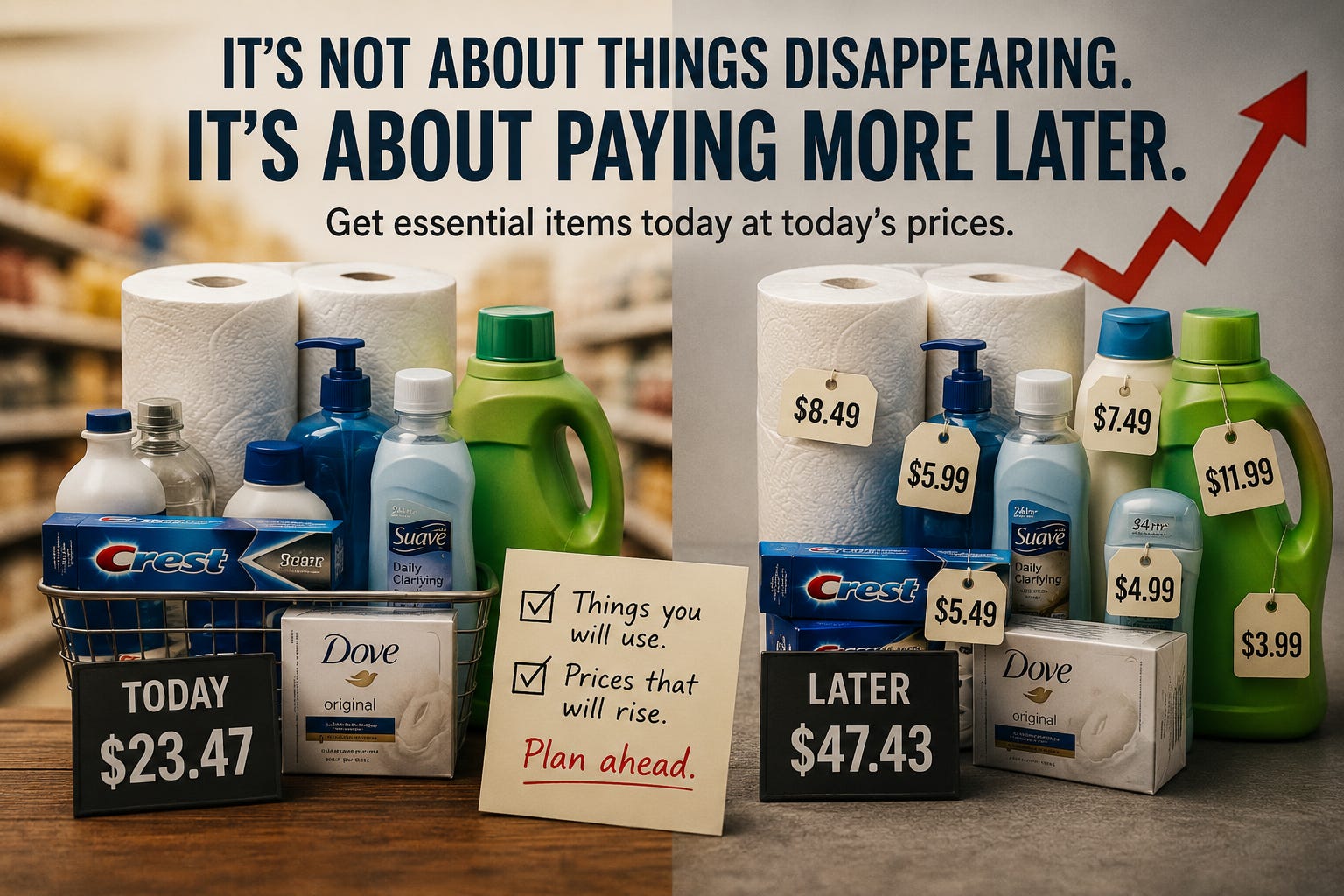
It’s Not About Things Disappearing. It’s About Paying More Later.

Lately I keep hearing the same warning everywhere:
“Buy what you can now before it’s gone.”
People say it about food, household goods, hygiene products, replacement parts, imported items—everything. The message usually sounds like we’re all one step away from empty shelves and total scarcity.
I think that misses the bigger point.
Yes, some things become hard to find. Some already have. Supply chain disruptions happen. Products get discontinued. Certain items disappear for stretches of time. We’ve all seen that.
But for most everyday things, I don’t think the real issue is, “It won’t exist next month.”
I think the real issue is:
You’ll still be able to get it next month—you’ll just pay more.
And then more after that.
And sometimes a lot more.
Because prices aren’t always rising in a slow, predictable line anymore. We’re seeing jumps. Sudden jumps.
The shampoo that used to be $6 is suddenly $8. The detergent that sat at one price for a year suddenly goes up by several dollars. A household item that quietly cost $12 last year is now $18 and somehow everyone acts like that’s normal.
We notice it in grocery stores first because groceries are constant. We buy them over and over. But it isn’t just food.
It’s hygiene products.
Toothpaste.
Soap.
Deodorant.
Paper products.
Laundry supplies.
Diapers.
Trash bags.
Basic things people use every single week without thinking.
And if you’ve been paying attention, many of these items are already significantly more expensive than they were not very long ago.
So when people say, “Buy extra now,” I don’t think it should automatically be dismissed as panic buying or fear.
There’s a difference between fear and math.
If I know I’m going to use toothpaste for the next six months anyway, and I can buy it at today’s price instead of next month’s higher price, that isn’t hoarding.
That’s planning.
If I know my household goes through detergent, shampoo, soap, toilet paper, and other basics at a predictable rate, buying extra while prices are lower isn’t irrational.
It’s buying tomorrow’s needs at today’s prices.
That’s a very different mindset than stockpiling because you think civilization is collapsing.
And honestly, I think a lot of people hear “buy now” and immediately imagine garages filled floor-to-ceiling with panic supplies and apocalypse fantasies.
That’s not what I’m talking about.
I’m talking about practical household economics.
If there are products you already use consistently, products with long shelf lives, products that have already shown a pattern of getting more expensive—then buying some ahead can simply make financial sense.
Not because shelves will be empty.
Because your money buys more today than it may buy later.
Now obviously there’s a line.
Going into debt to stockpile household products makes no sense. Draining savings to buy years of supplies isn’t smart. Buying things you won’t use before they expire is wasteful.
Fear can become expensive too.
But there’s also a mistake in pretending everything is fine and acting like prices haven’t changed dramatically.
People know what they paid.
They remember.
And increasingly, I think many people aren’t reacting to shortages.
They’re reacting to the feeling that every week their money quietly buys less than it did before.
Maybe that’s the real story.
Not:
“Get it before it disappears.”
But:
“Get it before your dollars shrink again.”
This hit home. I've been so grateful for everything I already have in the house and catch myself thinking "This may be all the yarn/fabric/shoes I *ever* have." Forbes reports that the price of a basic shopping cart of goods has increased almost 56% since 2020 alone.