
The Modern Coliseum
How a 34-minute livestream turned a human crisis into algorithmic spectacle—and made unwilling witnesses of us all

I did not go looking for the video of Perez Hilton. It came looking for me.
It appeared in my feed on X without warning, stripped of context and already detached from the TikTok livestream where it began. At first, I did not understand what I was seeing. Then I did. Hilton, seemingly experiencing an extreme mental break, appeared to be naked, covered in blood, and using a knife to harm himself repeatedly while speaking into his phone. The confusion of those first seconds gave way to horror—but by then the images were already inside me.
That is what social media has done to the boundary between public and private, witness and spectator, information and violation. A person can experience an extreme mental-health crisis in one place, broadcast it from another, and within minutes have it delivered to millions of strangers who never consented to see it. We no longer have to enter the arena. The arena opens beneath our feet.
According to viewers who tracked the broadcast, TikTok allowed the livestream to continue for 34 minutes before cutting it off. That duration has not yet been publicly confirmed by TikTok, but the recording itself was long enough for viewers to plead with Hilton, ask for information that could help them alert authorities, place emergency calls, and watch the crisis continue. Thirty-four minutes is not a glitch or a momentary failure. It is an eternity when a human being appears to be actively hurting himself in front of an audience.
And when TikTok finally ended the stream, the event did not end. Copies migrated to X, where the footage was posted, reposted, clipped, quoted, and pushed into feeds by a recommendation system that could not distinguish urgent news from a snuff spectacle. People who had never followed Hilton, never searched his name, and never asked to see graphic self-harm encountered it anyway. I was one of them.
The immediate story is about a person in crisis. The larger story is about everyone made into an audience—and about the institutions that profited from keeping the seats full.
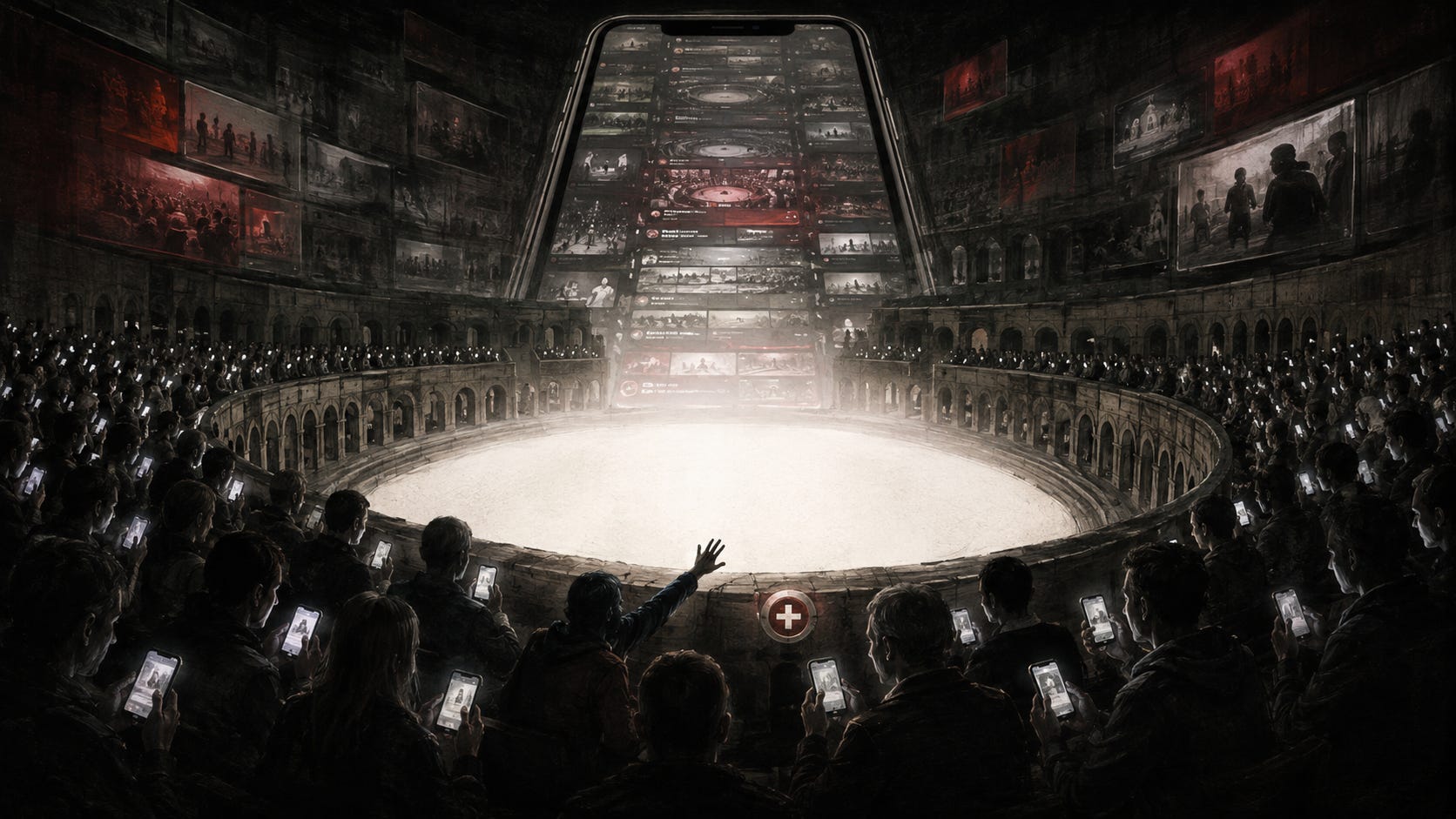
We have built a modern coliseum, one without stone walls or ticket booths, where suffering arrives in the palms of our hands. The spectacle finds us at breakfast, in bed, or in line at the pharmacy. It appears between a joke and an advertisement, asking nothing more than that we keep looking.
The comparison to the Roman arena is almost too easy, but the differences are revealing. In the old coliseum, power was visible. Caesar sat above the crowd. The violence had a location, a schedule, and an edge. Our arena is everywhere, always open, and governed by something less human than a tyrant: a system of incentives that does not know the difference between horror and delight. The algorithm recognizes only attention. Concern, cruelty, revulsion, pity, and morbid fascination all register as the same small electrical signal: engagement.
In this arena, we are not merely spectators. We are also camera operators, distributors, commentators, and unpaid promoters. Every replay enlarges the crowd. Every horrified repost extends the performance. We can tell ourselves we are raising awareness, expressing concern, or documenting reality, and sometimes we are. But the machinery beneath our intentions is indifferent. It converts our response into reach and a person’s worst moment into inventory.
There is a bitter symmetry in the fact that the person at the center of this episode was Perez Hilton. He rose to fame in an internet culture that treated the private lives, bodies, secrets, and humiliations of other people as public property. His work helped normalize the idea that exposure itself was entertainment. For years, the bargain of online celebrity was presented as simple: visibility was power, and privacy was the price.
But suffering is not made deserved by irony. A humane culture must be able to hold two truths at once. Hilton has caused harm. He also appears to have experienced a profound crisis. Accountability for the first does not require an audience for the second. If anything, the symmetry makes the moment more tragic. The machine does not honor its architects. Eventually, it consumes everyone—victim, perpetrator, celebrity, stranger—with the same appetite.
That appetite has changed more than media. It has changed us.
The responses beneath the reposted footage were their own kind of evidence. Alongside people expressing alarm, urging others not to share the video, and trying to find out whether Hilton was safe were reactions that were grotesque in a different way: jokes, mockery, disbelief, score-settling, and declarations that his past behavior made the present spectacle somehow deserved. Karma. Some people treated the footage as fake; others treated it as punishment; still others treated it as an opportunity to perform cleverness before the body on the screen had even reached safety.
This is what the coliseum does to the crowd. It does not merely show us cruelty. It recruits us into it. The comment box turns another person’s anguish into an open-mic night. Distance removes inhibition, virality rewards extremity, and the knowledge that thousands of others are watching diffuses responsibility until no individual feels responsible for anything. One person posts the footage “for awareness.” Another adds a joke. Another condemns the joke while reposting the same video. Each contribution seems small. Together they create the roar of the arena.
The trauma does not remain with the person at its center. Graphic images can shock, nauseate, destabilize, and linger in memory—especially for people with histories of self-harm, suicide loss, violence, or mental illness. Live viewers had to confront the terror of not knowing whether they were watching someone die. Those who encountered the footage later on X faced a different violation: they were given no meaningful choice at all. The video was simply there, moving in the feed, before context or consent could catch up.
It matters that I did not search for it. That is not a minor detail in the story; it is an indictment of the distribution system. We often speak as though harmful online content is something users choose to seek out and can avoid through better judgment. But algorithmic feeds invert that relationship. The platform chooses first. The user understands later. By the time we decide we do not want to see something, we have already seen it.
The conventional defense is that the internet merely reflects human nature. People have always gathered around disaster. They have always gossiped, stared, mocked, and turned pain into entertainment. That is true, but insufficient. A crowd once had to assemble. Now platforms assemble it automatically, at planetary scale, and earn money from every horrified pause. They do not merely reveal the appetite for spectacle; they cultivate, accelerate, and monetize it.
For most of human history, encountering a person in immediate distress imposed a moral demand. You were present; therefore, you had to decide whether to help. The screen weakens that demand by placing suffering at a peculiar distance: intimate enough to see, remote enough to feel unreal. We can stare into a stranger’s breakdown from inches away while remaining physically absent and morally uncommitted. The interface offers reactions, comments, screen recording, and sharing more readily than it offers the one instruction that matters: stop watching and get help.
Yet humanity did not entirely leave the building that night. Viewers called emergency services. People pleaded with Hilton to stop. Authorities reportedly used de-escalation tactics and brought him to a hospital. These acts matter because they reveal the moral distinction the platforms erase: the difference between witnessing and consuming.
To witness suffering is to recognize a claim on us. It means asking what the endangered person needs, protecting their dignity, and acting to reduce harm. To consume suffering is to ask what it makes us feel. Witnessing leads to intervention and then restraint. Consumption leads to another view, another replay, another opinion.
The two can look similar at first. Both begin with attention. But only one knows when to look away.
Our culture has become suspicious of looking away. We are told that visibility is inherently virtuous, that recording is accountability, that sharing is solidarity, and that silence is complicity. Those claims can be true when images expose abuses that power would otherwise conceal. But a person’s mental-health crisis is not automatically a public record, and virality is not the same as accountability. Sometimes refusing to circulate an image is not denial. It is mercy.
The most dehumanizing feature of the modern coliseum may be the collapse of categories. Emergency, confession, performance, evidence, entertainment, and advertising occupy the same feed and are judged by the same metrics. A breakdown can be followed by a dance. A war zone can precede a skincare promotion. The architecture discourages us from experiencing anything at its proper moral weight because everything must fit the same vertical rectangle and compete for the same flick of the thumb.
Eventually, we adapt. We develop the callus required to continue scrolling. We narrate disasters before they have ended. We search for hypocrisy in the wounded, entertainment in the unstable, and content in the dead. We call this being online, as though it were a place we visit rather than a set of habits we carry back into the world.
No policy can manufacture compassion, but platforms are not neutral stages. TikTok must answer how a livestream depicting apparent self-harm remained available for as long as it did. X must answer why graphic copies could spread so widely and be algorithmically inserted into the feeds of users who had not sought them out. Both companies decide what is amplified, what can be saved, how quickly graphic material spreads, and whether intervention tools are prominent or buried.
They can introduce friction where the business model currently demands velocity. They can make emergency reporting immediate, disable the redistribution of crisis footage, prevent graphic video from autoplaying, slow recommendation systems when harmful content is detected, and stop rewarding accounts that repackage human catastrophe for attention. These measures would not solve the deeper problem, but architecture helps train behavior. We built systems that teach us to consume; we can build systems that help us refrain.
The rest belongs to the crowd—to us. The humane response is almost countercultural in its simplicity: call for help. Do not record. Do not repost. Report copies when they appear. Do not turn uncertainty into commentary. Do not mistake access for entitlement. Resist the little surge of importance that comes from possessing an image everyone else wants to see.
Most of all, remember what the feed works so hard to make us forget: the figure on the screen is not a character arriving for our judgment. He is not a symbol, a plot twist, or a piece of content. He is a person living through what may be the worst night of his life. And the people who unexpectedly witnessed it are people too—not impressions to be harvested, but minds into which a platform has placed something they cannot simply unsee.
The modern coliseum has no single Caesar whose thumb we can restrain. Its power is distributed among companies, algorithms, cameras, and crowds. That makes responsibility harder to locate, but it also means the arena depends on participation at every level. Every spectacle requires an audience. Every algorithm requires material. Every platform makes choices about what it will permit to become profitable.
We may not be able to dismantle the coliseum overnight. But we can refuse to cheer. We can refuse to share. We can demand that the companies selling tickets stop pretending they have no control over the show. And, when another human being is suffering before us, we can remember that the first obligation of a witness is not to keep watching. It is to help.